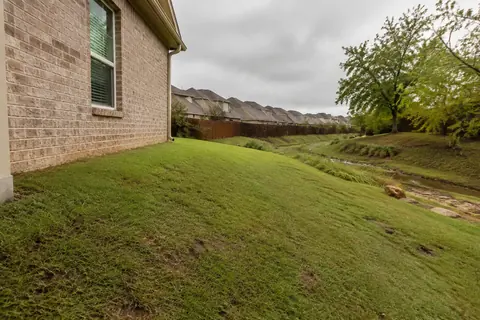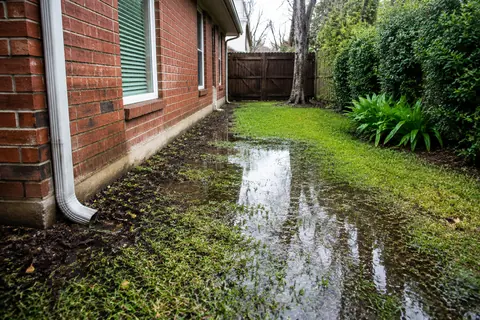
Start with where the water goes
French Drain Installation in North Texas
Evaluate the water source, collection points, discharge route and maintenance questions before installation.
Explore this service
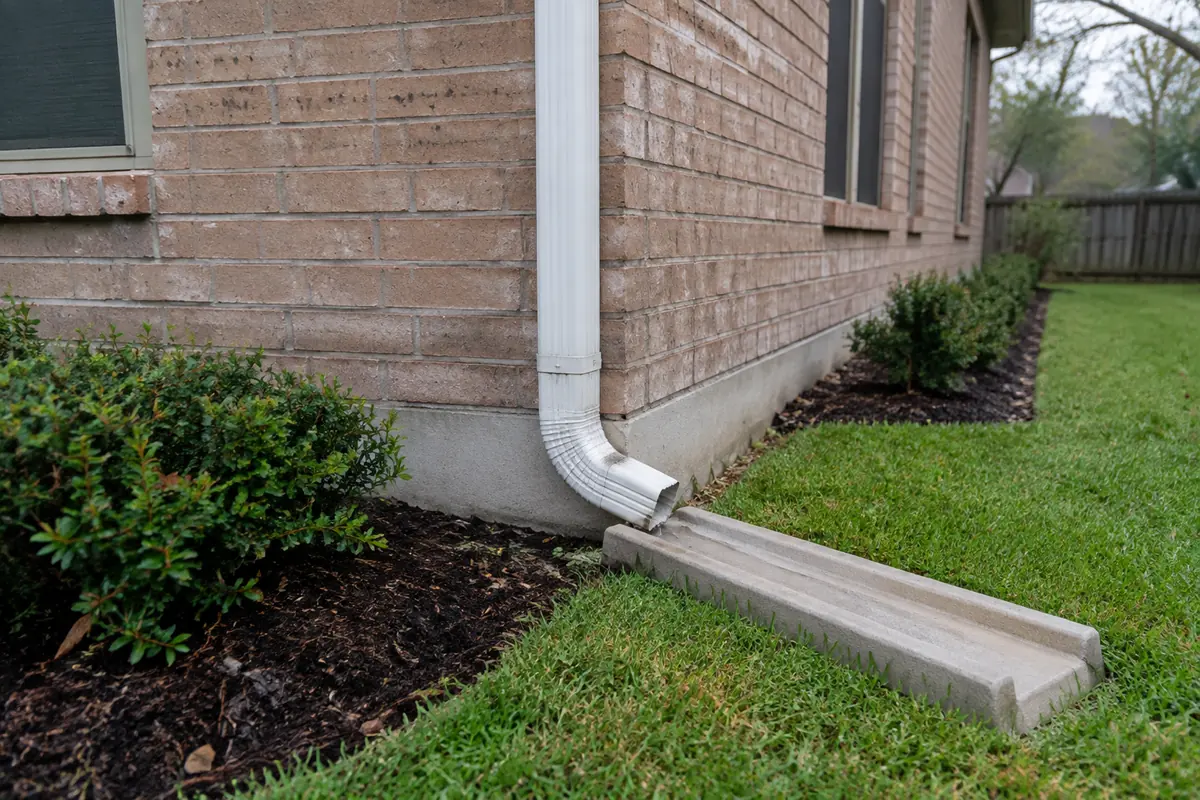
Follow roof runoff
A gutter can collect roof water successfully while the downspout still delivers it to a troublesome location. Follow the route all the way to the final destination. The useful questions are where the water lands, what it crosses, whether it collects near the house, and how any connected drain remains accessible for maintenance.
From a safe location, note where each downspout ends and whether the discharge is visible. During or after rain, photograph runoff crossing a walkway, collecting in a bed, or flowing toward the house. Do not climb onto a roof or inspect a gutter during hazardous weather. A qualified gutter professional can assess elevated components when needed.
Record whether the concern happens at one downspout or across several areas. A disconnected extension, an overflowing gutter, and a blocked buried line are different possibilities. Your notes should describe the visible behavior rather than assume the exact fault. Include recent gutter replacement or landscaping that changed the area around the outlet.
University of Maryland Extension explains that roofs and other hard surfaces generate runoff and that downspouts convey roof water away from the building. The practical homeowner question is what happens next. Water discharged onto a paved surface may continue toward another low point, so moving it a short distance does not necessarily complete the drainage path.
Look at the whole route: planting-bed edges, fences, patio slopes, and nearby surface drains may influence where flow goes. Ask a drainage professional whether the proposed destination suits the property. Avoid redirecting water toward another property or assuming a public drainage connection is available without the appropriate review and coordination.
If a downspout enters an underground pipe, locate any available plan, cleanout, or visible outlet. Tell the contractor what is known and what is uncertain. A buried connection can hide the final discharge point, so ask how the line's route and condition will be established if performance is in question.
Do not connect a downspout to an unknown pipe merely because it is nearby. Ask whether the system is intended to accept that water and how the connection would affect maintenance and flow. If a French drain is also proposed, clarify which components collect below-ground water and which carry concentrated roof runoff.
A practical roof-water map can be very simple: draw the house, place a mark at each downspout, and add an arrow showing the visible discharge route. Use a question mark where an underground destination is unknown. This reveals whether the concern is concentrated at one location or whether several downspouts feed the same area. It also helps a gutter contractor and drainage contractor discuss their separate work using the same landmarks, without assuming that replacing an elevated gutter resolves a destination problem at ground level.
A practical plan identifies the collection points, route, outlet, and accessible places for inspection or cleaning. Discuss extension placement so it does not create a trip obstacle or get repeatedly moved during mowing. Ask who handles gutter work, excavation, landscaping restoration, and any separate plumbing issue discovered during the review.
Pro-Tech can discuss drainage concerns and French drain installation as part of a site-specific conversation. Call 972-288-3797 or submit your property details for a scheduling call. Share photographs showing where roof water travels, along with any existing drain records, so the review can follow the route beyond the gutter.
Straightforward answers
It may address a local discharge issue, but the final water route and site conditions still matter. Ask where the redirected water will go after it leaves the extension.
No universal layout fits every property. Compare the proposed function, outlet, maintenance access, and surrounding site before choosing a buried or surface route.
Tell us what you have noticed. We will help you take the next step.
Keep exploring
Relevant services and practical guidance for the questions that come next.
Evaluate the water source, collection points, discharge route and maintenance questions before installation.
Explore this serviceStart with the source and destination of the water, not a drain product.
Read the guideA slope moves water somewhere; the destination must be part of the plan.
Read the guideLet's take a closer look
Tell us a little about your property. Our team will contact you to arrange your no-cost initial inspection.
(972) 288-3797Monday to Friday, 8:30 AM to 5:30 PM